
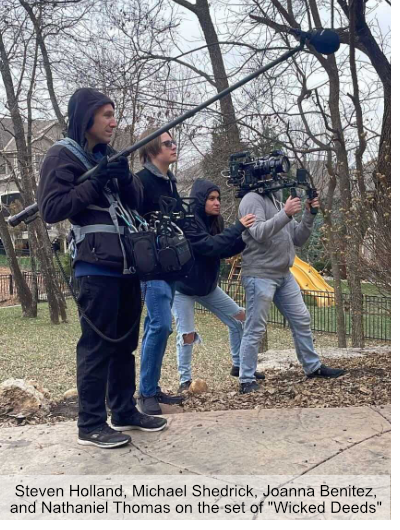
I sat down with Kansas City’s Michael Shedrick a short while ago, and we had a great conversation about his creative work and some of the lessons he’s learned along the way. What follows is the transcript of that discussion. You can view his production company's YouTube channel here: https://youtube.com/@tiltedlightproductions
Jacob Rhyder (JR):
Thanks Michael for sitting down with me to chat about your journey over the last couple of years. And I want to talk about Wicked Deeds a little bit as we go on and what it's like in the Kansas City area, really. So I really appreciate you taking the time to sit down and chat with me and go through all the fun stuff. The exciting bits, the challenging bits and just get to know you a little more.
Michael Shedrick (MS):
Awesome.
JR:
Yeah, cool, cool. So you're you're an actor, a director, writer, producer. That's a lot of hats.
Can I ask what got you interested in pursuing just so many different things in independent film-making?
MS:
I originally started with the Actor Training Studio in Kansas City as far as the Kansas City market goes.
I got into acting a long time ago when I was younger and I kind of took a hiatus from it for years and years. I did dabble with it in Arizona. I tried to get some traction there. Kansas pulled me back in. So I came back.
JR:
So are you from the Kansas City area?
MS:
I'm from Topeka. Yeah. And so after a few years of not really doing anything, I decided to look up acting classes and that's how I found Andy Garrison at the Actor Training Studio. I had a call with him and decided that was a good fit.
As far as getting into the film stuff, that is where I met Nathaniel Thomas. And I got to know him a little bit throughout it. We had some scenes together, a lot of fun. We talked about potentially doing a short film was like, “Hey, I've got a script if you're interested.” And he was like YEAH! And so he had a camera and all we needed was a location. Luckily, there was another gentleman in our Tuesday night class named Mike Stang. He had a location. We combined all of our powers and we made our first short film.
JR:
That sounds really, really interesting. How was that first experience in creating something that you've never created before?
MS:
It was a learning curve. There was a lot of — I learned a ton that first day. So I'm very, very thankful for that film. It was a lot of work in preparation. I've noticed that the more we've done this, the more work goes into it. It's like the better you get, the more work you have, kind of, I guess, because you want to set your standards up a little higher each time. So you do more of that the first time. I'm really fortunate to have the people that I had with me that day. It went pretty smooth. I was very nervous that day because it was the first time like, hey, we're doing something that I wrote. A script that I wrote! So hearing people read your words out loud, it can be a little nerve wracking and made me feel a little self conscious about it.
JR:
So was that script the first time you had ever filmed something that you'd written or has or anyone else taken something that you'd written and turned it into a finished film or a short film?
MS:
Yes, a finished one. Yes, for sure.
JR:
So, in what you just said, does that mean you'd started a few times and pulled back or got redirected or something else?
MS:
Yeah, yeah, I've always wrote things. I've dabbled in a little bit of novel stuff. I never finished anything, but I did get some chapters done and some of these things I was writing and I would write scripts just for fun in the hope that someday maybe I will film them. And I got a little bit of casting done. I want to say like 11 years ago on a couple of things, but it just it fell through. I didn't really know what I was doing.
JR:
Sure. Yeah, no, I understand that. So from what you mentioned about it, it was the actor training studio, you said — what you mentioned about that is that location, those acting classes seem to be where you found or developed or built, you started to build a community from.
MS:
Yes.
JR:
So it started there in the beginning. Is that a place that you return to to continue to build community or how are you finding other collaborators or actors or other people to work with?
MS:
So both. I still attend. I do some private work with Andy here and there. And as far as your other part of that question, it’s networking. So actors or other filmmakers that I meet, like for instance, I had L. Tanner Smith on. He plays Gary in a web series that we're doing and he's a filmmaker. So we cast him. I met him at, I think it was a Bird Watching Film Festival where we had a film playing there and hit it off with him, told him about the web series we were doing, cast him. He cast me in a couple of his projects and then I just kept meeting other actors and filmmakers and bringing them on if I like their vibe, you know, brought them on to set.
JR:
So is that is that process of almost stumbling upon somebody who you happen to vibe with? Is that process of finding that one person and then sort of building back and forth between them that you just described? Is that your version of networking? Because I know a lot of a lot of people have a lot of different ideas about what networking means to them.
MS:
No, I'd say mine's a lot more personable. Like, I, again, if I vibe with you and I feel like you're, you're genuine. I want to work with you more. To me that means the most and if you're, you know, if you show me you're responsible and
you communicate back and forth really well, and I really like your ideas and to me that's more important than talking loudly in a room full of people.
JR:
So for you it's a lot about that vibe, that back and forth vibe of collaboration and creation.
MS:
Yes, we're all in this together. I mean, you know, we're all in Kansas City.
JR:
So, you've mentioned that first project that you started you wrote and acted in. And that first one that you finished and then Wicked Deeds as well -- what are some of the challenges that you faced as an actor/director/whatever other role you're playing in those in those projects? What are some of the challenges that you faced and conquered?
MS:
So, the “dir-acting", I guess, is what I call it.
JR:
I'm sorry, can you spell that for me.
MS:
D-I-R-A-C-T-I-N-G. Diracting.
JR:
Okay. All right. I think you've just coined something here.
MS:
So, so that was a bit of a challenge for me especially in chapter one of Wicked Deeds. I didn't have anybody serving as AD I did have Nathan a little bit. But I didn't have a true AD to watch performances. So when I was acting, and it's the first time I've ever like really directed something of this magnitude. I was trying to act as well as watch what the other actor was doing. And so I would kind of take me out of it a little bit. Over time having an AD has served well so I can have them watch the performances when I am on set in character. And if we don't have an AD for the day I have just trusted the process and learned to trust the other actor and just stay in my character and trust that it will that will get what we want. And luckily, somebody will tell me usually part of the crew of something was really off.
JR:
So there's a lot of OJT for you, "on the job training," in this. And I was going to ask how you combated being taken out of acting mode into directing mode while you're doing a scene but you answered that in the trusting the people around you, building a crew and a team that has that trust is important to you.
MS:
100%. And that's a great compliment when somebody joins the Deeds set for the first time and they're like, the crew is amazing. And it just makes me feel so good.
JR:
Do you have any tips or techniques or maybe it's just something in your process that could help somebody who might be starting out doing what you've been doing and having to wear all of those hats is there something that a newcomer could go in thinking about or being aware of.
MS:
Like if they're wanting to direct act and produce?
JR:
Yeah. Oftentimes, people have to start small just because that's the nature of the game. So an individual would have to wear a lot of different hats and do a lot of different things. What is something or a few things, as you like, that a person might be able to take with them into that first or second project.
MS:
If they have people available and it's not just them, have a good support system, have people you can rely on and count on because I can't do any of this without the crew that we've had. Having that system is key. If you don't then I encourage anybody to get out there, whether it's an acting class or go to a film festival and just network because I found crew members and other actors at festivals that have joined on, as I said, and it's very important that you get out there and you get yourself established with some people, a crew.
JR:
Is that part of your process from a producer standpoint? You've talked a lot about acting and directing, can you tell me a little bit about your process as a producer to really solidify that team around you. You've talked about how you found them. I'm associating that with the producer level. Up until that first call of action in the day. What is it like to be a producer on that on your projects?
MS:
Are you asking for like, is this another advice question, or is this just...
JR:
It could be. I'm just interested in your experience as a producer. You've talked about directing and acting and “diracting."" So how is your experience as a producer on these projects, maybe differ from from those other roles?
MS:
I feel like there's a lot of there's actually a lot of work that goes into producing. From ordering props to, you know, locations and all those other elements. That's probably the most work, honestly, I mean, besides, they're all the acting the directing and producing all have a lot of work that goes into them, preparation in different ways. So, I think the production like that's just the beginning. Okay, where are we going to film at, who do I need. And then it goes down to the director when we get to set. Okay, this is how we're going to set this up and working with the DP and then we get down to the actor. Okay. And then, you know, how am I going to approach this scene. So it's even just talking about it. It's kind of just, you have to have a clear vision on what you want, especially for the day and there's some good advice that I got one time. I said I felt like I bit off more than I can chew and Nathan said "chew slowly." And so I think about that a lot. And so that is my advice for all this stuff is just chew slowly. Yeah, have a vision know what you want to do, especially for that day if you're breaking it up.
JR:
Interesting. So I'd like to talk about Wicked Deeds a little bit now specifically. We've filtered that in so far but I'd like to really focus on that. Can you tell me what it's about?
MS:
So Wicked Deeds follows the story of the Wallers. They are a crime family in the commercial real estate business based in the midwest, Kansas City area. The story revolves around the youngest brother Elliott Waller, who is going through the motions. They wind up, the Wallers wind up killing their accountant, named Gary Newman played by L. Tanner Smith. Gary and Elliot had this sort of friendship. Gary’s married to one of Elliot's best friends from high school, Amanda Newman played by Rachel Klewicki, and Gary winds up stealing money from the Wallers and Elliott has to kidnap him. And one of the brothers kills them in a field and that kind of starts the story with Elliot starting to have a tiny change of heart. And so it's about this guy that's done a lot of really really bad things. He's a product of his environment of his upbringing. He's been with his older brothers. They're a lot older than he is one by one decade one by two decades. So he's the baby brother, but they pretty much raised him. And so this is the life that he's known he thinks this is right. You know somebody crosses the family you put your family first. And so in this world, if what for whatever reason they need somebody gone, he helps make that happen. And so, losing a friend like that, and then dealing with the fallout of hurting his friend. And then a former flame of his comes back into his life.
JR:
Oh wow, that’s a lot. Can you sum it up for me in one or two sentences.
MS:
Yah, that’s hard there’s so many parts to it.
JR:
Can you can you distill it down. Can you boil away the things that happen into the things that matter, or the journey, or the theme?
MS:
I've always thought of it as trying to redeem yourself, when it might be a little too late for redemption. In essence, like, how when you're so far gone, how do you really redeem yourself if you even can, how is that even possible.
JR:
Okay. No spoilers here, so I'm not looking for spoilers. Do you know, do you know as the creator of the project, if that will happen. You don't have to tell me, but do you just know if it will or will not.
MS:
Yeah!
JR:
So you have the answer. Great! So you have a path, you have a full journey for the for those characters. Great!
What inspired you to create this story, or discover this story, whatever your process is, and then take it to the creation point?
MS:
So I originally wrote the first draft for Wicked Deeds, I want to say like 11-12 years ago. That was one of the projects I was trying to bring to life a long time ago. I changed it a lot. Originally the three brothers were all little more cuckoo than they are now, but I grounded it. And I wrote the pilot for that we used a lot, I don't as far as coming up with the idea I have. Maybe it's from influences from shows that I like I watched a lot of like Dexter, back in the day. I like gangster/mobster/serial killer/drama/crime story so I just wanted something in that genre. The character just popped into my head and that was it.
JR:
And they took off.
MS:
And then they took off.
JR:
Is there anything about that first chapter that was a surprise to you, and I mean literally anything from character or process or you know, anything throughout that, that was a surprise to you. Some difficulty that maybe you hadn't anticipated or a discovery.
MS:
That was a challenge you said?
JR:
It doesn't have to be a challenge just something that you maybe hadn't thought about. And it was a surprise to you when it came around or reared its ugly head if it is a challenge or something that maybe turned out differently than what you had expected when you were shooting it or writing it. Just a surprise.
MS:
Man, there's a lot of, there's a lot of little challenges throughout.
JR:
You can, I mean it doesn't have to be just one. You don't have to just pick one.
MS:
I would say how long it can take to get the shots that you want.
JR:
Got it. And is that longer or shorter than you expected?
MS:
Okay, so first it was longer. And I feel like as we've gone on and kind of found our group there's been some days where they've been a lot shorter because we know what we're doing more. The first time when you're learning, there can be some growing pains.
JR:
So is that, would you say that's something that you took out of creating in that first chapter? That you brought into the next and then the next and then the next.
MS:
Yes. Because we found, we kind of figured out what we like as far as what fits the chapters. We learned a lot from the first one and we just kept going with that.
JR:
So you're kind of, you're really dialing it in.
MS:
Yes.
JR:
That’s great! Do you have any pre-production or production rituals that you would feel confident or able to share with us?
MS:
No.
JR:
No? Okay. No rituals...
MS:
No rituals. Just planning. Write it all down. What do I need? What props do I need? Where are we filming?
JR:
Okay. Well, that seems like a ritual to me. Write it down and go do it.
MS:
Yeah. And I do like to physically write it down sometimes.
JR:
Has Wicked Deeds changed your approach to what you're doing? You kind of mentioned that in the the dialing it in component, but is there anything around your process outside of that that has changed your approach to what you're doing? A new path or a direction in storytelling or idea creation or...anything else?
MS:
Oh, I'll say directing has helped me with the acting aspect of it. Because when you direct and you study some directing, I feel like it helps you as an actor understand what the director is trying to get from you. And you already have an idea of what's going on. And really just learning all the stuff I've learned even with like lighting or little things. And it helps to know, I feel like it's very beneficial to learn everything you can about the set or the opportunity arises. I think all of that helps you become more, I would say, it just helps you overall become a stronger actor in my opinion.
JR:
Okay, so it all affects, everything affects everything is kind of what I'm getting from that, cool.
MS:
Yeah, learn what you can.
JR:
That's really interesting. Where would you like to see Wicked Deeds go? Say you've told the story to its conclusion, you've released the last chapter. What's next for Wicked Deeds? And if nothing, then maybe what's next for you? Or do you have prequels or sequels? Maybe Wicked Deeds: The Movie.
MS:
I mean, I've thought about the idea, yeah, see, and it's funny you say that. That's on the table if we get to the conclusion that I'm hoping we do. As far as expectations, I don't really have any. I'm happy with how it is. If it ever takes off and becomes something bigger, view-wise or however, or whatever we decide to do with it after it's all wrapped, awesome. Personally, I'm really proud of it and all the people involved. So I don't have any expectations for it. I would like to see it gain even more traction and have more people discover it. Yeah. And hopefully they enjoy it. As far as what happens after with that, if there could definitely be a sequel, depending on what happens to some of these characters. If there isn't one, or even if there is, I would like to keep creating short films from a writing/directing standpoint. I'm going to keep acting. I don't think I'll ever stop doing that. But creating a project from start to finish is very fulfilling. Each time we finish a chapter, it just feels so good when one of the chapters is done. Like once it's uploaded, once you set that premiere date...I don't want to say like a weight is lifted off your shoulders, but it kind of is, but it just feels, it just feels euphoric. I love it.
JR:
Euphoric!
MS:
All that hard work just paid off. There it is, we made it.
JR:
Incredible, that's incredible. You had just mentioned you'd like more people to discover it. Do you have any plans or thoughts on how to achieve that?
MS:
We've teased the idea of maybe a different streaming service besides YouTube. That's kind of touch and go. We'll see how that ends up. I'd like to finish season one at the bare minimum before we get to that. So we've got a few episodes left for that. Could be something we do when the whole show is wrapped and just try to go, "hey, here's a full show." Let's try to get it on there.
JR:
Sell DVDs.
MS:
Yeah. I mean, I've thought about that!
JR:
That’s fun.
MS:
But yeah, so, but YouTube's been good. Everybody's got YouTube, so.
JR:
That's true. You don't even have to have an account to watch on YouTube. That's a great distribution.
MS:
There's no reason you can't see it. Anybody can watch it.
JR:
So you had just mentioned about what's next for you. Continue writing, directing, producing. Do you have any projects, specific projects or stories in mind that you could mention?
MS:
Like that I'm writing or--
JR:
Yeah, that you're writing or directing or producing. Is there anything we should keep a lookout for?
MS:
So as far as writing, I do have a couple things. I can't really release too much information on those yet. I do have some drafts that I revisit. I'm trying to get through Deeds first before I really commit to that. But there are a couple that draw me back every so often that I'd really like to get off the ground.
JR:
How long do you think Wicked Deeds is gonna go on until it's completed to your satisfaction? Not to put you on the spot.
MS:
The plan at the moment, and things always change, are six episodes for season one, six episodes for season two.
JR:
And then that'll tell your story.
MS:
I feel like that will tell it enough to where it'll be satisfactory, yeah.
JR:
Okay.
MS:
Maybe not satisfactory for everybody, but I think we can get it to where we have a good conclusion.
JR:
Good, okay.
MS:
Good enough.
JR:
Great, great, great. I'll keep a lookout for that and I'll let you know if it's satisfactory to me or not. I'm just kidding!
MS:
Yeah!
JR:
Well, are there any final words of wisdom or anything you'd like to say?
MS:
If this was something you wanna do, go after it. Don't wait, don't procrastinate. Just do it.
JR:
And chew slowly...
MS:
And chew, take big bites, chew slowly.
JR:
Nice, that's great! Well, thank you for having a conversation today.
MS:
Of course, thank you for having me!
- Log in to post comments